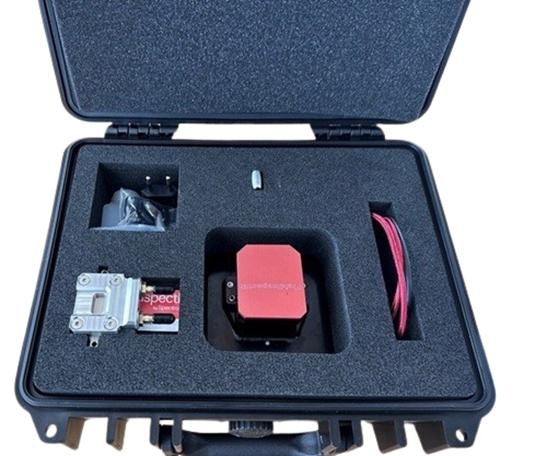
On-site fuel quality analysis for FAME%, ethanol content, water, and density — from a 2–3 ml syringe sample. Lab-equivalent results at the point of sampling, without sending fuel to an external laboratory.
The FluidInspectIR® Portable measures the key fuel quality parameters required for biodiesel and ethanol blend compliance, incoming fuel QC, and storage monitoring — delivering results comparable to certified laboratory methods from a single 2–3 ml syringe sample.
Quantifies the percentage of Fatty Acid Methyl Ester (FAME) in diesel fuel blends. Correlates with ASTM D7371 and customer blend specifications across B0 to B100 — the system is set up for one specific concentration, for example B40. Essential for incoming fuel QC and storage segregation.
⬇ DatasheetMeasures ethanol concentration in petrol/gasoline blends (E5, E10 and intermediate blends) across a measurement range of 0–20% v/v ethanol in gasoline. Enables rapid verification of blend ratio at delivery, at the pump, or during blending operations.
⬇ DatasheetDetects free and dissolved water in fuel samples. Water contamination is a primary cause of microbial growth, filter plugging, and injector damage — early detection prevents costly downstream failures.
Rapidly confirms the actual blend ratio of biodiesel and ethanol fuels against declared specification — at delivery, during blending, or from storage tanks — without laboratory delays.
Results correlate to the ASTM D7371 and D4815 standard methods and are displayed in the same units as conventional laboratory reports — directly comparable to certificate of analysis data from fuel suppliers.
The Portable fuel analyser is designed for use at fuel storage, blending, and dispensing facilities — anywhere fast, on-site fuel quality data is needed without the cost and delay of external laboratory testing.
No reagents, no sample preparation, no specialist training required. The Portable delivers fuel quality data immediately — at the point where the decision needs to be made.
Draw 2–3 ml of fuel directly from the delivery, storage tank, or blending vessel using a standard syringe.
Dispense the sample into the inlet tubing of the flow-cell and place it into the analyser. No dilution or preparation needed.
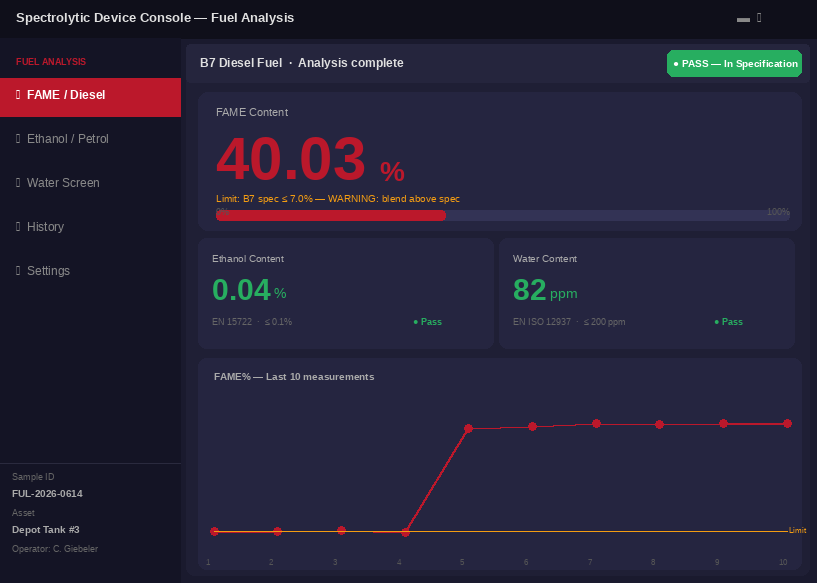
Select the fuel type in the software and press measure. Results for FAME%, ethanol, water, and density appear within minutes.
Compare results against specification limits on screen. Accept the delivery, quarantine off-spec fuel, or trigger a retest — before the tanker leaves.
The Spectrolytic Device Console runs on any Windows 10 tablet or laptop. Results are displayed in the same parameter format and units as conventional laboratory reports — no specialist training required to interpret the output.
The Portable eliminates the wait for external laboratory results at every point in the fuel supply and distribution chain where quality matters.
Test FAME%, ethanol content, and water on every tanker delivery before accepting it into storage. Detect off-spec blends, mislabelled deliveries, or contaminated fuel — before the tanker leaves.
Check FAME content in B5, B7, B10, B20, and higher blends against customer specifications, with results that correlate with ASTM D7371. Each system is set up for one specific concentration, for example B40. Avoid regulatory non-compliance and customer complaints from out-of-spec biodiesel blends.
Rapidly confirm E5, E10, and intermediate blend ratios across the 0–20% v/v ethanol range at the blending terminal or forecourt. Ensure the correct blend is dispensed into each grade — protecting both compliance and product integrity.
Screen fuel storage tanks and deliveries for water ingress. Water in fuel accelerates microbial growth, causes filter plugging, and damages injectors — early detection prevents costly equipment failures.
On-site QC at fuel terminals, distribution depots, and blending facilities. Replace slow external laboratory testing with immediate on-site analysis — speeding up release-to-dispatch decisions.
Test fuel quality at fleet depots and fuelling points before it enters vehicles. Protect high-value engines from FAME exceedances, water contamination, or incorrect fuel grades.